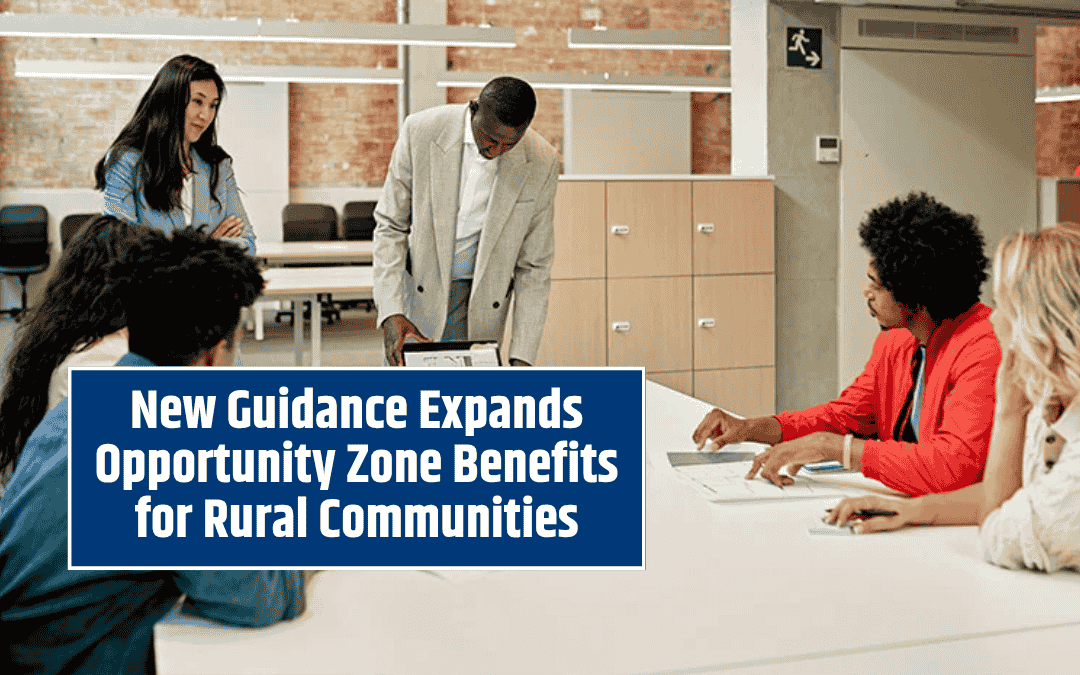
The Department of the Treasury and the Internal Revenue Service (IRS) have announced new guidance on Qualified Opportunity Zone (QOZ) investments in rural areas under the One, Big, Beautiful Bill (OBBB).
This update strengthens federal efforts to drive economic growth, job creation, and infrastructure development in some of America’s most underserved communities.
A Look Back: What Are Qualified Opportunity Zones?
Established in 2018, Qualified Opportunity Zones were created to attract private investment to economically distressed areas across the United States and its territories. By offering tax incentives to investors, the program encourages the flow of capital into regions that have historically experienced slow or limited economic growth.
Incentives That Drive Change
Investors who fund businesses or property development in designated QOZs can defer, reduce, or even eliminate certain capital gains taxes. These incentives help promote community revitalization, create new jobs, and improve local infrastructure—benefiting both investors and residents of these communities.
What’s New Under the One, Big, Beautiful Bill
On October 2025, the Treasury Department and IRS released Notice 2025-50, which clarifies two key provisions introduced under the OBBB. These updates refine the definition of rural areas and adjust the substantial improvement threshold for certain property improvements in QOZs located entirely in rural communities.
Defining “Rural Area” Under the New Law
Under the new guidance, a rural area is defined as any region that is not part of a city or town with a population greater than 50,000 and is not located within an urbanized area adjacent to such a city or town. This definition applies across all U.S. states, territories, and the District of Columbia, expanding eligibility for rural-based investment incentives.
Lowering the Investment Threshold for Rural Zones
The OBBB introduces a major update to encourage more rural development. As of July 4, 2025, the substantial improvement threshold for property in QOZs comprised entirely of rural areas has been reduced from 100 percent to 50 percent.
This means investors only need to make improvements equal to half of the property’s original basis to qualify for QOZ tax benefits.
Why This Matters for Rural America
Lowering the threshold significantly reduces financial barriers for investors, making it easier and more appealing to fund projects in smaller towns and rural communities.
This change recognizes that rural development often faces higher costs and longer timelines, and it helps ensure that these areas can fully benefit from the Opportunity Zone initiative.
Expanding Opportunities for Underserved Areas
There are currently 8,764 Qualified Opportunity Zones in the United States. Of these, 3,309 zones are located entirely within rural areas, according to Treasury’s latest notice.
Many of these communities have struggled for decades to attract new investment—this expanded eligibility aims to reverse that trend and stimulate sustainable local growth.
How the New Guidance Works
Notice 2025-50 applies to all tangible property located in a QOZ that meets the rural area definition and that has been, or is in the process of being, substantially improved on or after July 4, 2025. This includes commercial, industrial, and residential properties that qualify under the Opportunity Zone investment rules.
Simplifying the Path to Investment
The new guidance provides clearer standards and definitions to simplify compliance for investors and developers. By outlining which properties qualify and how the improvement thresholds apply, Treasury and IRS aim to reduce uncertainty and administrative burdens—making it easier for businesses and investors to bring much-needed resources to rural areas.
A Focus on Long-Term Development
These policy changes are not just about short-term investment—they are about long-term community development.
By incentivizing private capital to flow into neglected regions, the OBBB provisions encourage job creation, housing improvements, and the growth of small businesses, helping rural communities build stronger, more resilient local economies.
What’s Next for Opportunity Zones
The Treasury Department and IRS plan to issue additional guidance in the near future. This next round will cover new nominations and designations of Opportunity Zones authorized by the OBBB, setting the stage for an expanded program that reaches even more communities across the country.
Building on Past Success
Since the inception of the Opportunity Zone program, billions of dollars have been invested in distressed communities nationwide. These investments have helped revitalize downtowns, improve housing options, and support new small businesses.
The new rural provisions are expected to accelerate progress in areas that have historically lacked access to private investment.
Commitment to Inclusive Growth
The Biden administration’s focus on equity and rural revitalization continues through this initiative. By aligning tax policy with economic opportunity, the Treasury and IRS are reinforcing the government’s commitment to ensure that all communities—urban and rural alike—have the chance to thrive.
Learn More
For a full list of current Qualified Opportunity Zones, see Notice 2018-48 (PDF). To review the latest updates, including rural area classifications and investment thresholds, visit the IRS’s official website and download Notice 2025-50 (PDF). These resources provide detailed guidance for taxpayers and investors seeking to participate in the Opportunity Zone program.
FAQs
What are Qualified Opportunity Zones (QOZs)?
Qualified Opportunity Zones are economically distressed communities where new investments may be eligible for tax incentives. Created in 2018, QOZs encourage private investment to promote job creation and economic growth in underserved urban and rural areas across the United States and its territories.
What new guidance did the Treasury Department and IRS issue in 2025?
In 2025, the Treasury Department and the IRS released Notice 2025-50, which clarifies how Qualified Opportunity Zone provisions under the One, Big, Beautiful Bill (OBBB) apply to rural areas. The guidance defines what qualifies as a rural area and modifies the substantial improvement threshold for eligible properties.
How does the One, Big, Beautiful Bill define a rural area?
Under the new law, a rural area is any location outside a city or town with a population greater than 50,000 and not part of an urbanized area adjacent to such a city. This definition applies to all U.S. states, territories, and the District of Columbia.
What is the new substantial improvement threshold for rural QOZs?
As of July 4, 2025, the substantial improvement threshold for property located entirely in a rural Qualified Opportunity Zone has been reduced from 100 percent to 50 percent. This change lowers the amount investors must spend on improvements to qualify for QOZ tax benefits, encouraging more rural development.
Where can I find more information about Qualified Opportunity Zones?
You can review the full details in Notice 2025-50 (PDF) and Notice 2018-48 (PDF). The IRS website also provides a list of all 8,764 designated QOZs and ongoing guidance on new zones authorized under the One, Big, Beautiful Bill.