
The U.S. Department of Agriculture (USDA) has announced new SNAP benefit limits for November 2025, as the ongoing federal government shutdown compels the use of contingency funds to maintain payment distributions.
Why It Matters
The Supplemental Nutrition Assistance Program (SNAP), which provides food assistance to about 42 million Americans, has faced major disruptions during the ongoing government shutdown as lawmakers have yet to approve regular funding.
In October, federal officials cautioned that payments could be delayed and initially declined to use the USDA’s contingency funds, stating that those reserves were meant for emergencies such as natural disasters.
However, on Friday, federal judges in Rhode Island and Boston directed the government to continue funding the program—at least in part—by drawing on those emergency reserves. According to a Massachusetts court filing, the “USDA is making all of the Contingency Funds available to the States for a partial payment” of SNAP benefits.
What To Know
Maximum SNAP allotments are the highest monthly food assistance amounts a household can receive. They vary based on household size, with larger families receiving more, and can also differ by location, since states like Alaska and Hawai‘i have higher cost-of-living adjustments.
These allotments represent the benefit level for households with no countable income; most participants receive less because their benefits are reduced based on their earnings. In short, the maximum SNAP allotment reflects the upper limit of monthly support available.
For November, maximum amounts have been reduced. This is because the full appropriations required to fund SNAP benefits is not available, and will not become available until the government shutdown ends or standalone legislation is potentially passed mandating funding for the program.
How Much Is SNAP in November?
For a single person claiming SNAP in the 48 contiguous states, their monthly amount will be reduced to a maximum of $149, down from $292—a reduction of $143.
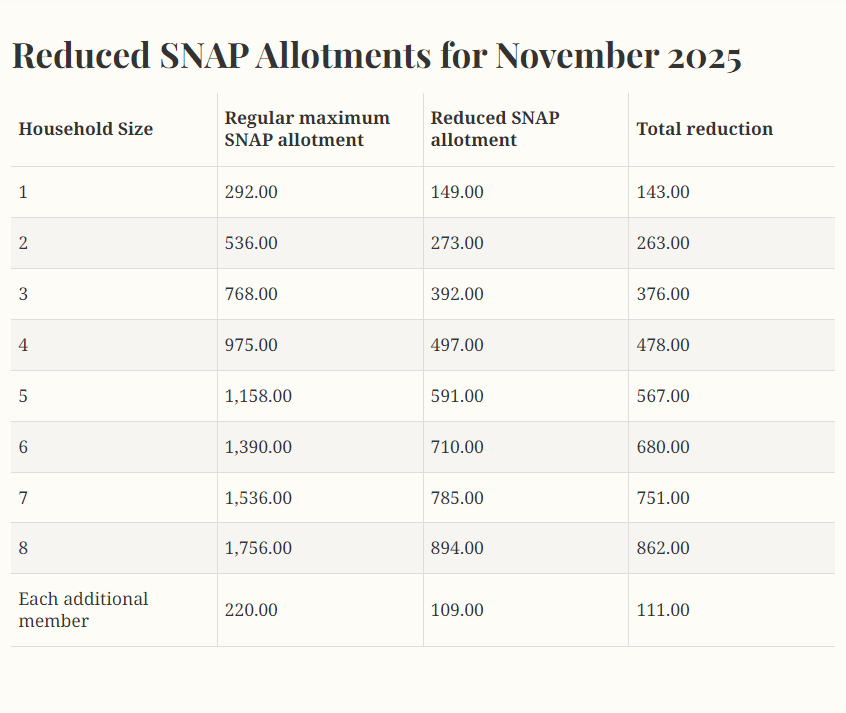
For a household of four, the usual maximum of $975 has been reduced to $497 per month.
Across all household sizes, the SNAP reduction is roughly 49 percent—meaning households claiming the top amount will get about half of their usual monthly benefit in November.
When Will Payments Arrive?
While SNAP is funded by the federal government, it is administered at the state and local level. This means that even in a regular month, SNAP benefits are paid at different times across the country. For now, an exact timetable on when SNAP will be delivered is not available.
“The recipients of the SNAP benefits need to understand it’s going to take some time to receive this money,” White House press secretary Karoline Leavitt said at a press briefing on Tuesday.
FAQ
Q1: Why are SNAP benefits reduced in November 2025?
Due to the ongoing U.S. government shutdown, the USDA is using limited emergency funds to continue payments, leading to a nearly 49% reduction in maximum benefits.
Q2: How much will I get from SNAP in November 2025?
A single person may receive a maximum of $149 instead of the usual $292. A household of four will get up to $497, down from $975.
Q3: Will SNAP benefits be paid on time in November 2025?
There is no fixed date yet. Since the program is run by individual states, payment timelines may vary and could be delayed.
Q4: Is this reduction permanent?
No, the cuts are temporary. Full benefits may resume once the government shutdown ends or Congress passes specific funding for SNAP.
Q5: What can SNAP recipients do to manage during this time?
Budget carefully, check state websites for updates, visit local food banks, and stay informed about any changes or possible retroactive payments.



I don’t know what it’s like to go out to eat Breakfast. We never have the money to go out. We right now lucky to have money to pay for cook anything. I don’t know have people are living. I pray everyday that things will get better. God we need help. We can’t get the Spending Card because they said we have wrong Medicare. I don’t think that some can and some can’t.